Articles and guides
Building bricks with a story: Hilary Page and Sluban
Author: Sluban HračkyOriginally published: Updated:
The simple idea of joining small bricks into a larger whole has a long history. Hilary “Harry” Fisher Page is an important figure in that story. His work helps explain the lasting appeal of an open-ended construction toy.
Hilary Fisher Page was a British toy designer associated with Kiddicraft and early interlocking plastic building blocks. His story highlights open-ended construction play. Its connection with Sluban is thematic, not a claim of corporate or licensed succession.
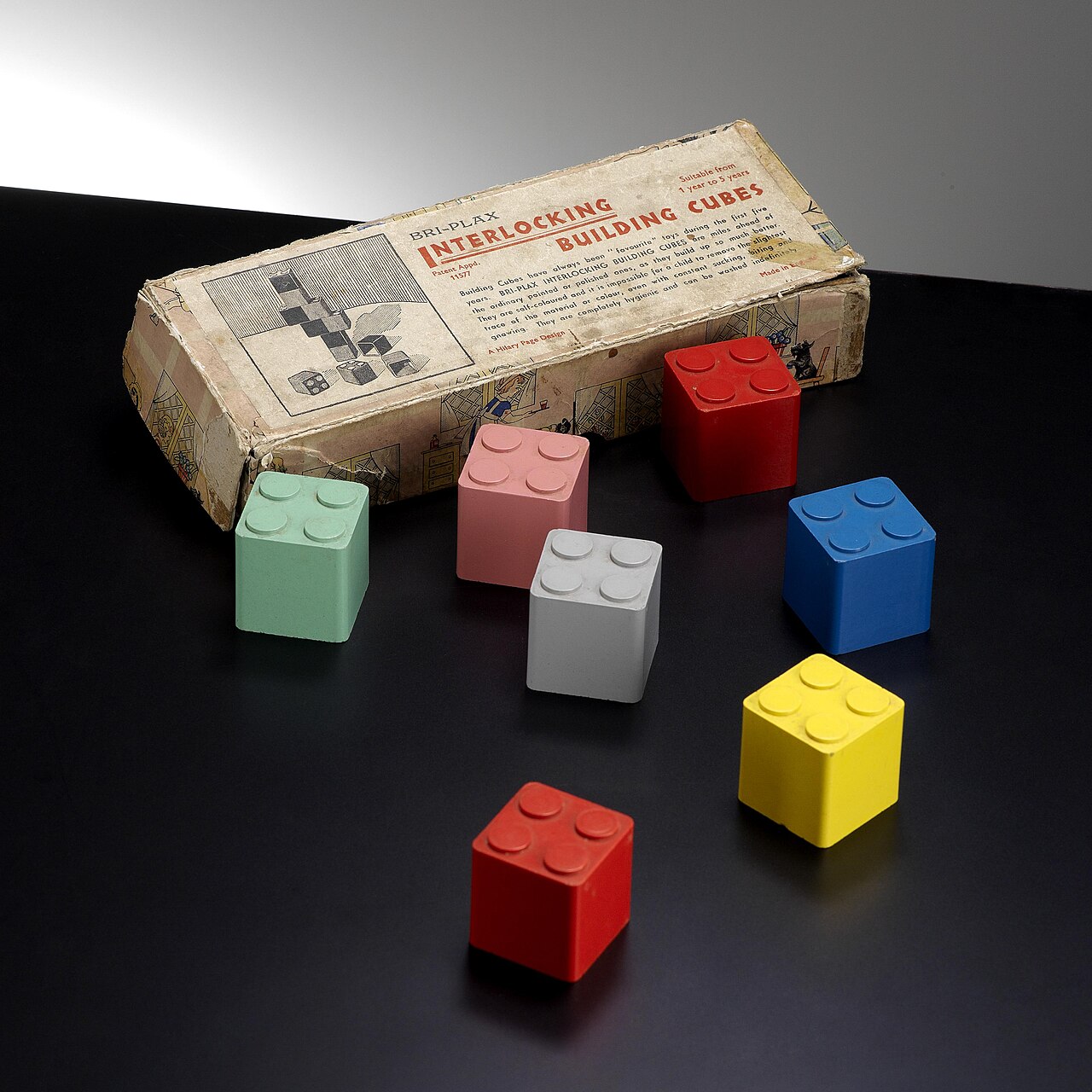
Photograph: Chas Saunter, CC BY-SA 2.0. Wikimedia Commons; image shown without cropping. Wikimedia Commons · CC BY-SA 2.0
Hilary Page and an open-ended toy
British toy designer Hilary Fisher Page brought together an interest in children’s play and experiments with shapes and materials. His work with Kiddicraft belongs to the early history of plastic building bricks. Instead of defining a single finished object, a construction system let children make their own.
That flexibility matters. The same piece can belong to a house, a vehicle or an unexpected invention. Finishing one model need not exhaust the possibilities: a builder can alter it, take it apart and begin again.
What the patent and museum sources tell us
The application for British patent GB529580A, concerning improvements in toy building blocks, was filed on 17 April 1939. The patent document was published on 25 November 1940. Distinguishing these dates is more accurate than assigning the whole development to a single year.
The V&A describes Page’s plastic interlocking cubes in the 1930s and the 1947 Self-Locking Building Bricks design, shown at Earl’s Court. The British Toy & Hobby Association lists Hilary Page as a 2007 Lifetime Achievement Award recipient. Links to these sources appear below.
From early bricks to Sluban today
Sluban belongs to the wider modern world of interlocking construction toys. The connection to Page’s story is the principle of open-ended building: separate parts acquire a purpose in the builder’s hands. This comparison does not imply legal succession between the brands or a licence from Kiddicraft.
The Sluban catalogue applies construction to city scenes, vehicles, ships, technical subjects and decorative models. Different purposes call for different choices. Accessories and figures can matter for imaginative scenes; proportions and finished dimensions matter for a display model.
Build a story of your own
Assembly can lead into another kind of play. Where a set includes figures, a driver can take a seat, a shop can open or a rescue team can prepare a mission. Movable figure parts help place a character within a scene.
Metropolis and Town offer city environments, while Girls Dream adds settings for travel and storytelling. Cars, motorcycles, ships and space models introduce other interests. The best starting point is what the individual builder likes to explore, rather than a general assumption about who should enjoy a theme.
What hands and minds do while building
Handling small parts involves precise finger movements and coordination between eyes and hands. Following an illustration adds spatial orientation, attention to sequence and comparison of shapes. Counting studs and noticing symmetry give simple mathematical ideas a purpose.
A misplaced part creates a chance to find a cause and plan a repair. Building with someone else involves explanation and shared responsibilities. Completing an appropriate challenge can bring a sense of achievement and independence. These are opportunities within the activity, rather than a promise of identical benefits for every child.
Choosing a model worth returning to
Decide whether the main aim is imaginative play, rebuilding or displaying a finished model. Compare the individual set’s age recommendation, piece count, contents and dimensions. More pieces do not automatically make a set more interesting or more suitable.
ModelBricks includes Titanic in different versions for larger projects. Loose Builder bricks and Bricks Base plates can support original designs. Each product code has its own photographs and available information; older models remain in the archive. Comparing these details is more useful than relying on a box image alone.
An idea that continues with the next build
Page’s story highlights the value of a toy that leaves room for the child’s decisions. A simple system can offer many routes from an initial attempt to an original idea. Sluban adds specific themes and constructions in which that principle can continue.
A completed model may begin a story, inspire a rebuild or recall time spent together. The companion Sluban STEAM article offers practical examples for discussing construction and choosing a challenge that fits the builder’s experience.
Product ranges
- Sluban Metropolis – city buildings, vehicles and connected play
- Sluban Girls Dream houses, animals and stories
- Sluban Builder models and creative bricks
- Sluban Power Bricks moving vehicle models
- Sluban Army military building sets
- Sluban ModelBricks detailed model building sets
- Sluban Titanic ship building models
Frequently asked questions
Who was Hilary Fisher Page?
A British toy designer and pioneer of early interlocking plastic building blocks associated with Kiddicraft.
Does this mean Sluban directly succeeded Kiddicraft?
No. The connection discussed here is the principle of open-ended construction play, rather than documented corporate or licensed succession.